
Handle grip span for optimising finger-specific force capability as a function of hand size
Abstract
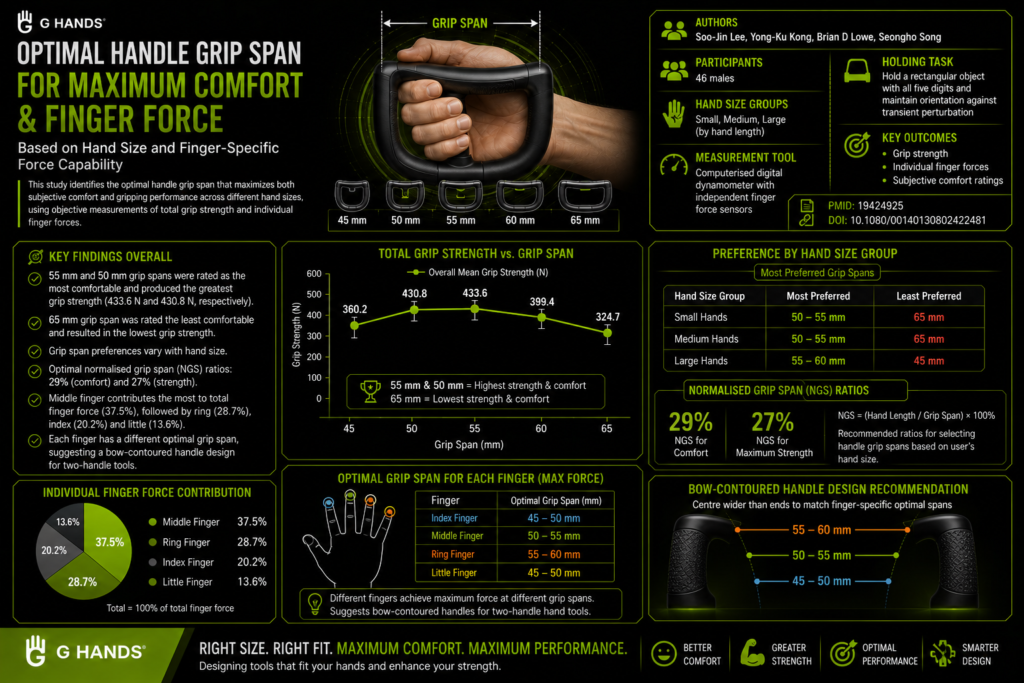
Five grip spans (45 to 65 mm) were tested to evaluate the effects of handle grip span and user’s hand size on maximum grip strength, individual finger force and subjective ratings of comfort using a computerised digital dynamometer with independent finger force sensors. Forty-six males participated and were assigned into three hand size groups (small, medium, large) according to their hands’ length. In general, results showed the 55- and 50-mm grip spans were rated as the most comfortable sizes and showed the largest grip strength (433.6 N and 430.8 N, respectively), whereas the 65-mm grip span handle was rated as the least comfortable size and the least grip strength. With regard to the interaction effect of grip span and hand size, small and medium-hand participants rated the best preference for the 50- to 55-mm grip spans and the least for the 65-mm grip span, whereas large-hand participants rated the 55- to 60-mm grip spans as the most preferred and the 45-mm grip span as the least preferred. Normalised grip span (NGS) ratios (29% and 27%) are the ratios of user’s hand length to handle grip span. The NGS ratios were obtained and applied for suggesting handle grip spans in order to maximise subjective comfort as well as gripping force according to the users’ hand sizes. In the analysis of individual finger force, the middle finger force showed the highest contribution (37.5%) to the total finger force, followed by the ring (28.7%), index (20.2%) and little (13.6%) finger. In addition, each finger was observed to have a different optimal grip span for exerting the maximum force, resulting in a bow-contoured shaped handle (the grip span of the handle at the centre is larger than the handle at the end) for two-handle hand tools. Thus, the grip spans for two-handle hand tools may be designed according to the users’ hand/finger anthropometrics to maximise subjective ratings and performance based on this study. Results obtained in this study will provide guidelines for hand tool designers and manufacturers for designing grip spans of two-handle tools, which can maximise handle comfort and performance.
Similar articles
-
Kong YK, Seo MT, Kang HS.Ergonomics. 2014;57(1):108-15. doi: 10.1080/00140139.2013.851284. Epub 2013 Nov 6.PMID: 24192400
-
Hand span influences optimal grip span in boys and girls aged 6 to 12 years.
España-Romero V, Artero EG, Santaliestra-Pasias AM, Gutierrez A, Castillo MJ, Ruiz JR.J Hand Surg Am. 2008 Mar;33(3):378-84. doi: 10.1016/j.jhsa.2007.11.013.PMID: 18343294 -
Kong YK, Kim DM.Int J Occup Saf Ergon. 2015;21(2):187-92. doi: 10.1080/10803548.2015.1029726.PMID: 26323777
-
Schreuders TA, Selles RW, Roebroeck ME, Stam HJ.J Hand Ther. 2006 Oct-Dec;19(4):393-401; quiz 402. doi: 10.1197/j.jht.2006.07.024.PMID: 17056399Review.
-
Objective evaluation of manual performance deficits in neurological movement disorders.
Nowak DA, Hermsdörfer J.Brain Res Rev. 2006 Jun;51(1):108-24. doi: 10.1016/j.brainresrev.2005.10.003. Epub 2005 Dec 13.PMID: 16356552Review.
Cited by
-
Cepriá-Bernal J, Pérez-González A.Sensors (Basel). 2021 Apr 7;21(8):2594. doi: 10.3390/s21082594.PMID: 33917212Free PMC article.
-
Multiaxis grip characteristics for varying handle diameters and effort.
Irwin CB, Towles JD, Radwin RG.Hum Factors. 2015 Mar;57(2):227-37. doi: 10.1177/0018720814544212. Epub 2014 Jul 22.PMID: 25850154Free PMC article. -
Sayadizadeh M, Daliri M, Rahimi M, Salehipour P, Sadeghi M, Mozafari JK, Moradi A.BMC Musculoskelet Disord. 2024 Oct 12;25(1):809. doi: 10.1186/s12891-024-07914-z.PMID: 39395954Free PMC article.
-
Altered phalanx force direction during power grip following stroke.
Enders LR, Seo NJ.Exp Brain Res. 2015 Jun;233(6):1677-88. doi: 10.1007/s00221-015-4241-9. Epub 2015 Mar 21.PMID: 25795079Free PMC article. -
Grip force makes wrist joint position sense worse.
Li L, Li S.Front Hum Neurosci. 2023 May 31;17:1193937. doi: 10.3389/fnhum.2023.1193937. eCollection 2023.PMID: 37323932Free PMC article.
Related information
LinkOut – more resources
-
Full Text Sources